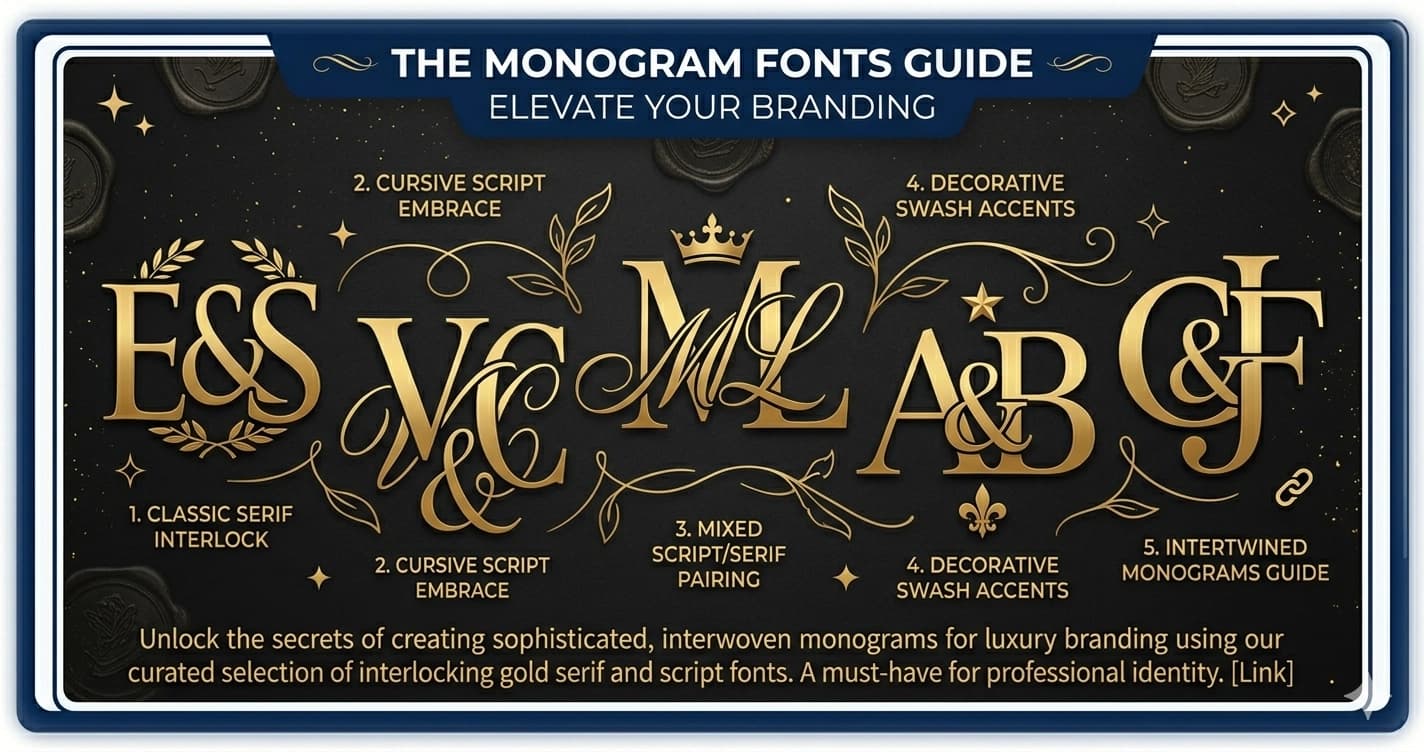
Monogram Fonts — History, Styles, and How to Create Personalized Initials
A monogram is one of the oldest forms of personal branding. Greek and Roman rulers stamped their coin dies with interlocked initials. Medieval monarchs sealed documents with elaborate letterform combinations. Victorian embroiderers stitched initials into linens. Today, monograms appear on everything from luxury leather goods to wedding stationery to Instagram bios.
The consistent thread across three thousand years: a monogram uses letterforms to signal identity, ownership, and status. The font style you choose for a monogram communicates as much as the letters themselves.
What Is a Monogram?
A monogram is a design composed of one or more initials — typically one, two, or three letters — used to represent a person, couple, brand, or institution.
Types of monograms:
Single initial — One letter, usually enlarged and decorated. Used for personal items (stationery, towels, jewelry), brand marks, and profiles. The simplest and most versatile form.
Two-letter monogram — Two initials combined or placed side by side. Common for professional identity (first initial + last initial) and couple monograms (two first initials).
Three-letter monogram — The traditional form for individuals: first, middle, last initials. In the classic arrangement, the last name initial appears in the center and is larger than the two flanking first and middle initials. For couples: his first initial, joint last initial (center, enlarged), her first initial.
Interlocked monogram — Letters combined into a single overlapping design, sharing strokes. Requires custom design work; can't be replicated purely through Unicode styling.
A Brief History of Monograms
Ancient Origins
The earliest known monograms appear on Greek and Roman coins. Rulers used combined letter designs — often overlapping initials — as marks of royal authority on currency. The monogram served the same function a modern logo does: immediate visual identification of the source.
The Chi-Rho (☧) — a monogram formed from the first two letters of "Christos" in Greek (Χ and Ρ, Chi and Rho) — is one of the most historically significant monograms in Western history. Adopted by Constantine I as his battle standard in 312 CE, it became one of the earliest symbols of Christianity and demonstrates how a two-letter combination can carry the weight of an entire institutional identity.
Medieval Heraldry
Heraldic monograms developed as part of the broader system of coats of arms and personal insignia in medieval Europe. Monarchs and noble families used elaborate letterform combinations in illuminated manuscripts, carved stonework, and personal seals.
Royal monograms became particularly codified. The British Royal Cypher — the monogram used by the British monarch — appears on official letterheads, military uniforms, pillar boxes, and government buildings. Each reign produces a new monogram: EIIR for Elizabeth II, CR for Charles III. The design is formally commissioned, carefully executed, and carries the weight of institutional authority.
Victorian Embroidery and the Domestic Monogram
The 19th century brought monograms into everyday domestic life. Victorian embroidery culture established the convention of marking household linens — towels, bedsheets, pillowcases, handkerchiefs — with the owner's initials. Embroidery pattern books and later sewing machine attachments made this accessible beyond the wealthy, and the practice of monogrammed household goods became widespread.
This Victorian tradition established the three-letter monogram format (first-last-middle, with last in center) that remains standard for personalized gifts today.
Modern Luxury Branding
Luxury brands have taken the monogram to its most visible contemporary form. The LV (Louis Vuitton) monogram print, the CC (Coco Chanel) interlocked design, the GG (Gucci), the FF (Fendi) — these are among the most recognized marks in global commerce. They function simultaneously as brand identification, status signal, and design pattern.
What these luxury monograms share: distinctive letterforms, high visual contrast, and immediate recognizability at any size from handbag hardware to full-pattern fabric. They're designed to be reproduced at massive scale while remaining unmistakable.
Font Categories for Monograms
The font style determines almost everything about what a monogram communicates. The same two initials in Gothic vs. Script vs. Sans-Serif produce completely different identity signals.
Script and Cursive
The traditional choice for personal monograms, particularly for weddings, gifts, and personal stationery. Script fonts convey elegance, warmth, and personal connection.
Best for: Wedding monograms, bridal gifts, personal stationery, jewelry, feminine personal branding.
What to look for: Clear letterform even at small sizes; strokes that don't close in on themselves when embroidered or engraved; sufficient visual weight for single-letter applications.
Unicode equivalents: Bold Cursive (𝓑𝓒) and Cursive (𝒜𝐵) approximate the script family. The flowing, looping quality of Bold Cursive makes it the strongest Unicode option for script-style monograms.
Serif (Classic and Slab)
The formal choice — serif monograms signal tradition, authority, and heritage. From traditional three-letter Victorian monograms to institutional letterheads, serif is the default for formal contexts.
Best for: Corporate identity, professional stationery, institutional use, traditional gifts, men's accessories.
What to look for: Clear serifs that will survive reduction in size; sufficient contrast between letterforms when two or three are combined.
Unicode equivalents: No direct serif equivalent in common Unicode styled fonts — the standard Mathematical Alphanumeric Symbols focus on script, Gothic, and double-struck variants.
Gothic / Blackletter
Gothic monograms carry the weight of historical authority — diplomas, religious texts, newspaper mastheads. They read as serious, institutional, and culturally weighty.
Best for: Men's accessories, streetwear branding, dark aesthetic applications, any context wanting to signal heritage and gravitas.
What to look for: Legibility at reduced sizes (Gothic can become illegible when small); single-letter applications work better than combined three-letter Gothic monograms.
Unicode equivalents: Gothic/Fraktur (𝔊𝔅) — the Mathematical Fraktur block provides the closest Unicode approximation.
Sans-Serif (Modern Geometric)
Clean, modern, professional. Sans-serif monograms read as contemporary and design-forward — the choice for modern brands and minimalist personal identity.
Best for: Modern business identity, tech company logos, minimalist personal branding, any context where clean simplicity signals sophistication.
What to look for: Geometric structure that reads well as a mark; good negative space between letterforms.
Unicode equivalents: No dedicated sans-serif monogram Unicode equivalent — standard Latin characters are closest.
Double-Struck
A distinctive choice with both mathematical heritage and strong aesthetic appeal. Double-struck monograms have a scholarly, structured quality.
Best for: Dark academia aesthetic, academic identity, STEM context, profiles wanting intellectual associations.
Unicode equivalents: Double-Struck/Blackboard Bold (𝔻𝕊) — full alphabet available.
Unicode Styled Initials: What Works
Unicode styled fonts provide a quick, no-design-software way to create styled initial combinations for social media bios, profile names, and digital applications.
| Aesthetic | Unicode Style | Two-Letter Example | Three-Letter Example |
|---|---|---|---|
| Elegant / Wedding | Bold Cursive | 𝓐𝓑 | 𝓐𝓑𝓒 |
| Scholarly / Academic | Gothic | 𝔄𝔅 | 𝔄𝔅ℭ |
| Dark Academia | Double-Struck | 𝔸𝔹 | 𝔸𝔹ℂ |
| Minimalist | Small Caps | ᴀʙ | ᴀʙᴄ |
| Y2K / Bold | Bubble | ⒶⒷ | ⒶⒷⒸ |
| Technical | Monospace | 𝙰𝙱 | 𝙰𝙱𝙲 |
| Retro | Vaporwave | AB | ABC |
How to use on social media:
- Instagram Name field: Two or three styled initials as a personal mark.
𝓐 · 𝓑(with a separator) is more readable than𝓐𝓑run together. - Discord display name: Initials + separator + name.
𝔄𝔅 · Alexanderuses styled initials to mark the name without overwhelming it. - TikTok bio: Styled initials as a visual marker at the start of a bio line.
Limitations: Unicode styled initials are a practical approximation of professional monogram design. They work for digital applications — social media, digital stationery, email signatures. For physical applications (embroidery, engraving, printing on products), a professionally designed monogram file from a graphic designer or an embroidery/engraving service is the appropriate tool.
Monograms by Occasion
Wedding Monograms
Wedding monograms are one of the highest-demand use cases for personalized letterforms. They appear on invitations, programs, ceremony signage, wedding websites, napkins, favors, and thank-you cards.
The traditional three-letter convention: First initial, LAST initial (larger, center), Middle initial. For a couple: His first initial, SHARED LAST initial (larger, center), Her first initial.
Font recommendations for weddings:
- Script / Cursive — romantic, traditional, widely expected
- Elegant Serif — formal, clean, works well at small sizes on engraved items
- Modern Sans-Serif — for contemporary minimalist weddings
Digital applications: A styled Unicode monogram works well for wedding websites, digital invitations, and social media posts announcing the wedding. For printed materials, a professionally designed monogram ensures quality at print resolution.
Corporate and Professional Identity
Professional monograms typically use initials of the company name (not personal initials). The design standard is cleaner and less decorative than personal monograms:
- Two letters: Company initials (IBM, GE, JP)
- High legibility at any size
- Often sans-serif or geometric
- Negative space as a design element
For personal professional branding (consultant, freelancer, independent professional), a two-letter first+last initial monogram in a clean serif or modern sans-serif signals professionalism without the formality of a full company brand.
Personal Items and Gifts
The Victorian tradition of monogrammed personal items remains a significant gift market. Towels, robes, tote bags, phone cases, notebooks, leather goods — monogrammed with the recipient's initials.
Font considerations for physical items:
- Embroidery: Needs substantial stroke weight; thin serifs disappear. Script and block fonts work best.
- Engraving: High contrast; both serif and sans-serif work if letterforms are clean.
- Printing: Most formats work; test at the final print size before committing to large quantities.
DIY vs. Professional Monogram Design
When Unicode / DIY Works
- Social media bios and display names
- Digital communications (email signatures, online profiles)
- Personal use (phone wallpaper, casual stationery)
- Quick mockups and previews before committing to professional design
When to Hire a Designer
- Wedding invitation suites (the monogram will be reproduced across multiple items at varying sizes)
- Physical products (embroidery, engraving, printing on merchandise)
- Brand applications (business cards, letterhead, company identity)
- Anything where the monogram will appear at large scale or in contexts where professional quality is expected
The cost of a professional monogram design from a skilled designer ranges from $50–$300 for a personal use monogram to $500–$2000+ for a full brand identity application. For wedding applications, a custom monogram is typically bundled into the invitation design cost.
Create Styled Monogram Initials
Generate Unicode styled initials for any combination of letters at Lettertype:
- Bold Cursive (wedding, elegant) — Bold Cursive Generator
- Gothic (heritage, authority) — Gothic Font Generator
- Double-Struck (academic, structured) — Double-Struck Generator
- Small Caps (clean, minimal) — Small Caps Generator
Type your initials, copy, and use in any digital context.