Calligraphy Through the Ages — From Ancient Scripts to Digital Fonts
Writing by hand with care — that's the original definition of calligraphy. The word comes from the Greek kallos (beauty) and graphein (to write). But calligraphy as a practice spans every writing system in human history, takes radically different forms across cultures, and has left its mark on every typeface ever designed.
The cursive fonts, script letterforms, and Gothic characters that appear in Unicode today are direct descendants of calligraphic traditions that are thousands of years old. Understanding where they came from changes how you see them.
The Origins of Calligraphic Writing
The Alphabet and the Scribe
Writing systems are older than alphabets. Cuneiform (Mesopotamia, ~3200 BCE) and hieroglyphics (Egypt, ~3100 BCE) preceded alphabetic writing by millennia. But neither system encouraged the kind of flowing, rhythmic letterwork that defines calligraphy in most traditions.
The Phoenician alphabet (~1050 BCE) — 22 consonants, no vowels, written right to left — created the conditions for calligraphic practice. Because it was a phonetic system (one sign, one sound), it could be learned and written quickly. Scribes developed the tools and techniques that made beautiful writing possible: reed pens, papyrus, ink.
From the Phoenician system derived Greek (which added vowels, ~800 BCE), from Greek derived Latin (adapted ~600 BCE), from Latin derived the scripts that form the basis of Western calligraphy.
Roman Inscriptional Capitals
The letterforms carved into Roman monuments — the Senate columns, triumphal arches, dedication stones — establish the foundational proportions of Western capital letterforms that persist to the present day.
The most studied inscription is Trajan's Column (113 CE) in Rome, a 30-meter monument covered in carved relief depicting Trajan's Dacian wars. The inscription at the base — the Capitalis Monumentalis — uses letterforms of such precise geometric proportion that they have served as a reference for type designers for five centuries.
Every serif capital letter in any Western typeface — Times New Roman, Garamond, Georgia — traces its proportions directly to Roman inscriptional letterforms. The serifs themselves are thought to derive from the finishing strokes of the broad reed pen used to paint letters before they were cut into stone.
The Major Western Calligraphic Scripts
Uncial (4th–8th century)
As Christianity spread and required the rapid reproduction of religious texts, scribes developed Uncial — a rounded, legible script that could be written faster than Roman capitals without sacrificing readability.
Uncial is characterized by rounded letterforms with only minimal ascenders and descenders (the parts of letters that extend above or below the main body). It was the dominant script of early Christian manuscripts across Ireland, Britain, and continental Europe.
Half-Uncial (a variant with more pronounced ascenders and descenders) led directly to the development of minuscule scripts — lowercase letterforms as distinct from capitals.
The Book of Kells (~800 CE), the Lindisfarne Gospels (~715 CE), and other Insular manuscripts from the British Isles show the peak of the Uncial tradition — extraordinarily detailed, illuminated lettering that integrates calligraphy, illustration, and decorative pattern into unified compositions.
Carolingian Minuscule (9th–11th century)
Charlemagne's court scholar Alcuin of York standardized a new script — Carolingian Minuscule — as part of the Carolingian Renaissance (~780–820 CE). The goal was a unified, legible script that could be read and written consistently across the Frankish Empire.
Carolingian Minuscule established features we now take for granted in Western writing: clear distinction between capitals and lowercase, spaces between words, standardized punctuation. The script was clean, round, and relatively easy to reproduce consistently.
Renaissance humanists, who rediscovered classical texts written in Carolingian Minuscule, believed they were reading ancient Roman script. They adopted it as the basis for Humanist typefaces — which became the ancestors of modern Roman type.
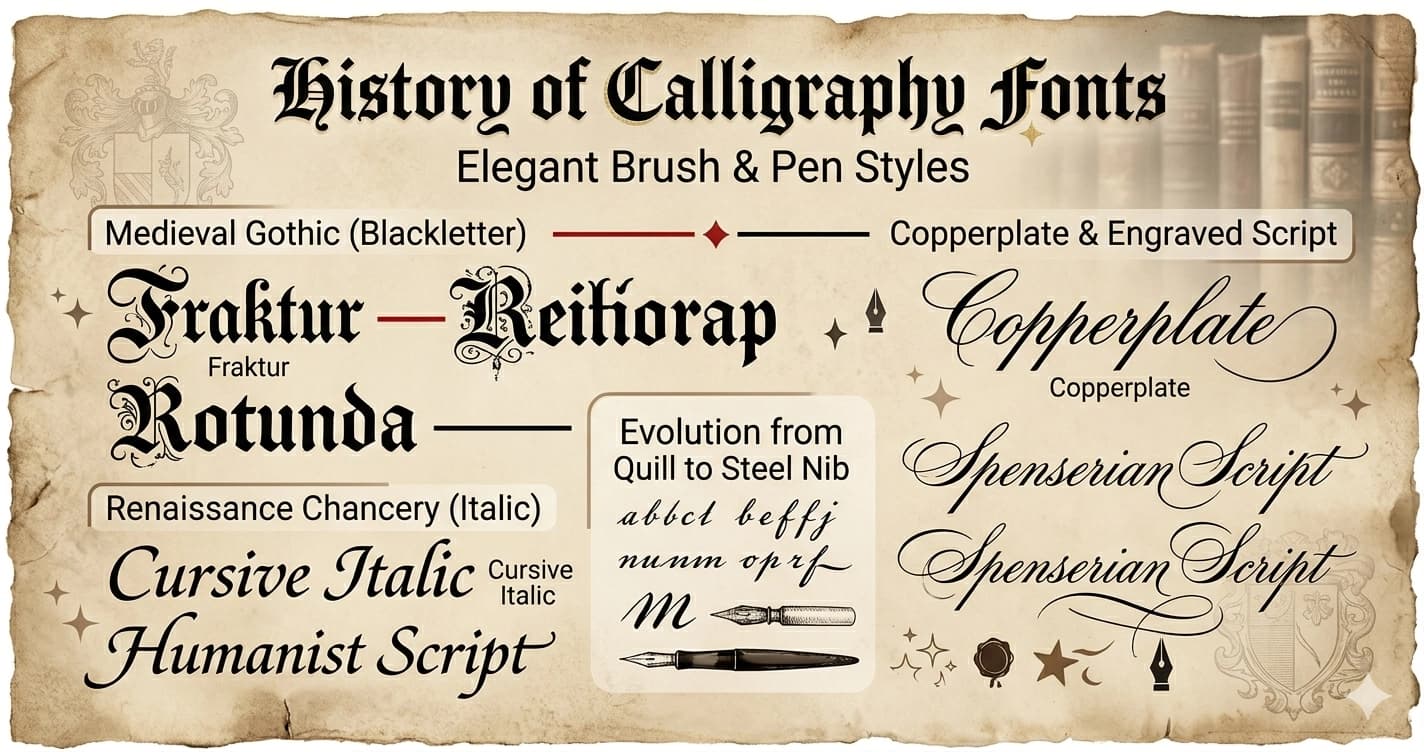
Gothic / Blackletter (12th–17th century)
As manuscripts became more numerous and books more compact, scribes needed to pack more text into smaller spaces. Gothic script (also called Textura or Blackletter) compressed Carolingian Minuscule's rounded forms into angular, dense strokes that were faster to write and allowed more characters per line.
Gothic script dominated Western European manuscripts from the 12th century through the invention of printing. Gutenberg chose Gothic type for his Bible precisely because it resembled the familiar hand that readers expected.
Regional variations developed: Textura (the most formal and compressed), Schwabacher (slightly rounded, common in everyday German use), and Fraktur (the refined German court variant, commissioned by Emperor Maximilian I in 1513). Fraktur persisted as the dominant German script until 1941.
Italic (15th–16th century)
The Renaissance humanists who adopted Carolingian Minuscule also developed a faster cursive variant for everyday use — Chancery Italic or Cancellaresca, developed in the Papal Chanceries of 15th-century Rome and Florence.
Aldus Manutius, the Venetian printer, commissioned typographer Francesco Griffo to cut the first italic typeface in 1501. The Aldine Italic was designed to pack more text per page than upright Roman type — it was an economic decision as much as an aesthetic one. Manutius used it for his famous series of pocket-sized classical texts.
The italic cut by Griffo established the basic proportions and slant angle of every italic typeface since. The convention of using italic for emphasis, titles, and foreign words in text set in Roman type was established in this period and remains standard today.
Copperplate and Spencerian (17th–19th century)
The development of metal engraving in the 17th century created a new calligraphic style suited to the engraver's burin: Copperplate, characterized by extremely fine hairline upstrokes and swelling downstrokes, with elaborate flourishes and great dynamic contrast between thick and thin.
Copperplate became the standard for formal correspondence, business documents, and invitation printing through the 18th and early 19th centuries. The script's look — elegant, refined, demanding considerable skill — became synonymous with "formal" lettering.
Spencerian Script, developed by Platt Rogers Spencer in the 1850s, was a simplified, more teachable variant designed for American business correspondence. It was the dominant American business hand until the typewriter displaced it in the early 20th century. The original Coca-Cola and Ford logos were written in Spencerian or closely related scripts.
East Asian Calligraphy
Chinese Brushwork
Chinese calligraphy is one of the most technically demanding and culturally significant calligraphic traditions in the world. The Four Treasures of the Scholar's Studio — brush, ink stick, paper, and inkstone — define the implements of a tradition stretching back three thousand years.
Chinese calligraphy has five major script styles, each with distinct aesthetic qualities and historical associations:
| Style | Chinese | Period | Characteristics |
|---|---|---|---|
| Seal Script | 篆書 (Zhuàn) | ~1000 BCE | Archaic, formal; used on seals |
| Clerical Script | 隸書 (Lì) | Han Dynasty (206 BCE–220 CE) | Angular, wave-like finishing strokes |
| Regular Script | 楷書 (Kǎi) | Wei-Jin period (220–420 CE) | Standard printed form; formal |
| Running Script | 行書 (Xíng) | Han Dynasty | Semi-cursive; everyday use |
| Cursive Script | 草書 (Cǎo) | Han Dynasty | Highly abbreviated; expert only |
Chinese calligraphy is practiced as an art form, a meditative practice, and a status marker. Historically, mastery of calligraphy was a prerequisite for government service — the imperial examination system tested calligraphic skill as a measure of education and character.
Japanese Calligraphy: Shodo
Japanese calligraphy — Shodō (書道, "the way of writing") — developed from Chinese brushwork after Japan adopted the Chinese writing system in the 5th–6th centuries CE. Japanese calligraphers adapted Chinese techniques to Japanese writing systems (hiragana and katakana, syllabic scripts developed in the Heian period, ~794–1185 CE) as well as continuing to practice Chinese-style calligraphy with Chinese characters.
Japanese calligraphy emphasizes the energy and movement of the brush stroke — the beginning of the stroke (入筆), the movement through (走筆), and the ending (収筆). The quality of a stroke is evaluated not just by its visual form but by the evidence of the brush's movement through time.
Islamic Calligraphy
Islamic calligraphic tradition emerged with a specific theological dimension: because representational art depicting the human figure is prohibited in orthodox Islamic tradition, calligraphy became the supreme art form in Islamic civilization.
The Arabic script — written right to left, with 28 letters that change form depending on position in a word — developed into multiple distinctive styles:
Kufic — the earliest developed Arabic script (~7th century CE), angular and highly geometric. Used for early Quranic manuscripts and architecture. The angularity allowed precise stone carving and tiling.
Naskh — a cursive, rounded style that became the standard for Quranic text and is the basis of most printed Arabic type today.
Thuluth — a large-scale monumental script used for architectural inscriptions, title pages, and decorative panels.
Diwani — an ornate Ottoman court script known for its extreme curvature and ligatures.
Islamic calligraphy appears on mosque walls, illuminated Qurans, tile work, metalwork, and textiles across a geographic range from Spain to Central Asia. The integration of writing and visual art reaches its peak in works where the entire visual composition is formed from arranged calligraphic characters.
The Transition to Type and Digital Lettering
Printing and the End of Manuscript Calligraphy
Gutenberg's printing press (1450s) didn't immediately end the manuscript tradition — scribes and calligraphers remained in demand for another century for documents requiring personalization, legal authentication, or artistic quality that early printing couldn't replicate.
But printing fundamentally changed calligraphy's role. Where calligraphy had been the production technology for text, it became an art form — practiced for its aesthetic value rather than its communicative efficiency.
Why Fonts Are Not Calligraphy
Typefaces derived from calligraphic models — script fonts, italic fonts, cursive fonts — are approximations of calligraphy, not calligraphy itself.
The essential quality that type cannot replicate: variation. Every stroke of a calligrapher's hand is slightly different from the last. Ink pressure varies. Brush angle shifts. The beginning of a long letter has a different quality from the end when the ink runs slightly thin. This variation — controlled but not mechanical — is what gives calligraphy its life.
A digital font uses the same letterform for every instance of a given character. The lowercase 'a' in a calligraphic font is identical every time it appears, regardless of what surrounds it. Some advanced OpenType features (contextual alternates, stylistic sets) attempt to introduce variation — different forms of the same letter appearing based on context — but these are programmed approximations of organic variation, not the real thing.
Unicode styled text is even further removed: the characters in the Mathematical Script and Mathematical Fraktur blocks are standardized symbols derived from calligraphic models, presented identically in every context.
What Unicode Approximates
The Unicode Mathematical Alphanumeric Symbols block (U+1D400–U+1D7FF) provides character sets that approximate several calligraphic traditions:
- Mathematical Script (𝒜, 𝐵, 𝒞...) approximates the broad-pen cursive tradition of Copperplate and Chancery Italic
- Mathematical Fraktur (𝔄, 𝔅, ℭ...) approximates the Gothic/Blackletter tradition
- Mathematical Bold Script (𝓐, 𝓑, 𝓒...) is a bolder variant of the script style
These characters were designed for mathematical notation but carry the aesthetic qualities of their calligraphic originals. Pasted into a social media bio or caption, they read as calligraphic even though they're technically standardized Unicode symbols.
Calligraphy Today
Modern calligraphy practice has split into several streams:
Traditional calligraphy — practitioners of Copperplate, Spencerian, Italic, and other historical Western styles; Chinese and Japanese brush calligraphy; Arabic calligraphic traditions. These are artistic practices requiring years of dedicated study.
Modern calligraphy / brush lettering — a simplified, more accessible approach that has grown dramatically in popularity through Instagram and Pinterest. Modern calligraphers use brush pens, felt-tip markers, and flexible nibs to create letter-based art that references calligraphic qualities without strict adherence to historical scripts.
Digital lettering — Illustrators and type designers who create lettering digitally, using drawing tablets and software. The output is a designed letterform rather than a physical mark.
Type design — The design of typefaces that draw from calligraphic traditions. The best script and cursive typefaces are designed by people with deep calligraphic training who understand the movement and pressure dynamics that give calligraphic letterforms their character.
Generate Calligraphy-Inspired Unicode Text
The closest digital approximation to calligraphic scripts available without software or design skill:
- Bold Cursive (Mathematical Bold Script) — Bold Cursive Generator
- Cursive (Mathematical Script) — Cursive Generator
- Gothic / Fraktur (Mathematical Fraktur) — Gothic Font Generator
- Italic (Mathematical Italic) — Italic Generator
Copy and paste into any platform that accepts Unicode text.